📊 Data & Analytics Tools for RevOps
Data enrichment, cleansing, routing, and intelligence platforms. The data infrastructure RevOps owns to keep the GTM engine running on clean fuel.
Key Takeaways
- Headline coverage numbers mean little until you test a vendor on a sample of your own target accounts.
- Contact data decays constantly, so refresh cadence and stale-record flagging matter as much as initial accuracy.
- Intent and technographic signals are only valuable if they demonstrably predict buying in accounts like yours.
Reviews
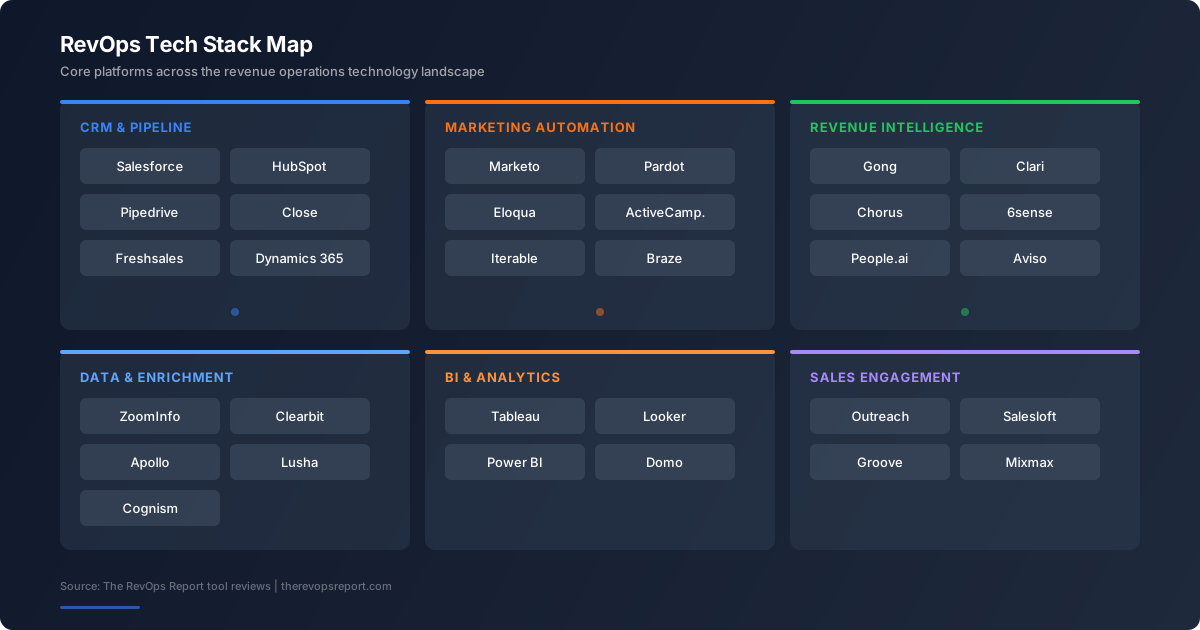

Waterfall data enrichment with 75+ providers. Clay is the breakout tool for RevOps and GTM engineers who want to build c...

All-in-one sales intelligence and engagement platform. For RevOps teams at SMB and mid-market companies, Apollo replaces...

Enterprise B2B contact and company data platform. ZoomInfo is the data standard RevOps teams at large companies run on, ...

Website visitor identification with AI-powered outbound automation. RevOps teams use Warmly to turn anonymous website tr...

Intent-driven outbound platform combining 25+ signals with execution. For RevOps teams building signal-based outbound mo...

Enterprise no-code data orchestration and automation. Openprise is the heavy-duty data ops platform for enterprise RevOp...

Salesforce-native data deduplication and cleansing tool. For RevOps teams fighting the endless battle against duplicate ...

Lead routing and GTM orchestration platform. LeanData is the tool RevOps teams use to solve the lead-to-account matching...

Enterprise ABM platform with account intelligence and data enrichment. RevOps teams at enterprise companies use Demandba...
AI-powered managed data cleaning, enrichment, and analysis services. For RevOps teams that need data ops done but don't ...

ABM intent data platform that reveals anonymous buying signals to identify in-market accounts. RevOps teams use 6sense f...

Inbound scheduling and lead routing platform. RevOps teams deploy Chili Piper to eliminate the speed-to-lead gap between...

The largest B2B intent data cooperative, tracking content consumption across 5,000+ publisher sites. Bombora provides co...
Comparisons
- Clay vs Apollo
- ZoomInfo vs Apollo
- Warmly vs Unify
- ZoomInfo vs Clay
- Demandbase vs ZoomInfo
- 6sense vs Demandbase
Alternatives Guides
Data and analytics tools for RevOps cover the layer that fills, cleans, routes, and scores go-to-market data: enrichment, prospecting databases, intent signals, account-based intelligence, and routing. The goal is a clean, complete, well-targeted dataset feeding the CRM and the rest of the stack.
Who These Tools Are For
- RevOps teams responsible for CRM data completeness, account scoring, and lead-to-rep routing.
- Demand and ABM teams that need firmographic, technographic, and intent data to target the right accounts.
- Operations leaders trying to cut the time reps waste on manual research and bad-fit leads.
How to Evaluate Data & Analytics Tools
Coverage and accuracy for your market
Vendor accuracy varies sharply by geography, company size, and industry. A database that is excellent for US enterprise may be thin for European SMB or a niche vertical. Always test on a sample of your own target accounts before trusting headline coverage numbers.
Refresh cadence and decay
Contact data decays continuously as people change jobs. Ask how often records are re-verified and whether the vendor flags stale data. A stale enrichment source quietly poisons routing and outreach long after the contract is signed.
Signal quality over signal volume
Intent and technographic data is only useful if it predicts buying. Be skeptical of large signal counts; ask for evidence that the signals correlate with pipeline in accounts like yours, and pilot before scaling spend.
Workflow fit
Enrichment that does not write cleanly into your CRM and routing rules creates more manual work, not less. Confirm the tool fits your existing data model and ownership rules rather than forcing a parallel process.
The Data & Analytics Landscape
This is the broadest category on the site, spanning enrichment databases, account-based intelligence, intent providers, and routing engines. The reviews below cover the data and analytics vendors RevOps teams evaluate most, and the comparisons help you separate raw coverage from signal quality and workflow fit.
Jump to a review: Clay · Apollo.io · ZoomInfo · Warmly · Unify · Openprise.
Coverage is not the same as accuracy
Vendors in this category compete on database size, but size is the wrong thing to buy on. What matters is the match rate and field-level accuracy on your specific target market. A provider with hundreds of millions of records can still be thin for European SMB, a niche vertical, or the exact titles you sell to. The only honest test is to run a sample of your own accounts through a trial and measure the fill rate and accuracy on the fields you actually use for routing and scoring.
The decay problem
Contact data is a depreciating asset. People change jobs continuously, so a record that is accurate today is wrong within months. This is why refresh cadence matters more than initial accuracy: a vendor that re-verifies frequently and flags low-confidence fields keeps your routing and outreach grounded, while a one-time bulk append slowly poisons the CRM. RevOps should treat enrichment as a maintained pipeline with periodic re-verification, not a single purchase.
Signals worth paying for
Intent and technographic data carry the highest variance in this category. A long list of in-market accounts is only useful if those accounts convert at a higher rate than your baseline. Before scaling spend, run the signal against a holdout and check whether flagged accounts actually progress. Many teams pay for impressive-looking signal volume that, on inspection, does not predict buying any better than chance in their segment.
Common Mistakes RevOps Teams Make
- Buying on database size rather than match rate and accuracy on your own target accounts.
- Treating enrichment as a one-time append and letting the data decay until routing and outreach quietly break.
- Paying for high-volume intent signals without proving they predict buying in your specific market.
The Bottom Line
This is the broadest and noisiest category on the site, so discipline matters: test coverage and accuracy on your own accounts, treat enrichment as a maintained pipeline rather than a one-time append, and prove that intent signals predict buying before scaling spend. The vendors profiled above span enrichment, account intelligence, intent, and routing, and the right combination is the one that keeps your specific go-to-market data clean and well targeted.
Frequently Asked Questions
What do data and analytics tools do for RevOps?
They fill, clean, route, and score go-to-market data: enriching CRM records, supplying prospecting and intent data, and routing leads to the right rep. The aim is a complete, accurate, well-targeted dataset that every downstream tool and forecast can trust.
How do I evaluate a data enrichment vendor's accuracy?
Do not trust headline coverage claims. Pull a sample of your own target accounts and check the vendor's data against ground truth for fields you care about. Accuracy varies by geography, company size, and industry, so test on your real market.
Is intent data worth the cost?
Only when the signals predict buying in accounts like yours. Intent data has high variance in quality, so pilot it against a holdout and check whether flagged accounts actually convert at a higher rate before committing significant budget.
Why does enrichment data go stale?
People change jobs, companies restructure, and titles shift continuously, so contact records decay by a meaningful percentage every year. The fix is a vendor that re-verifies records frequently and flags low-confidence data, plus a hygiene process to remove decayed records.
Should enrichment write directly into my CRM?
Yes, but on your terms. Enrichment that respects your data model, field ownership, and routing rules reduces manual work. Enrichment that overwrites good data or creates a parallel process adds cleanup, so test the write behavior before turning it on broadly.