COMPARISON
Chili Piper
VS
LeanData

Chili Piper vs LeanData 2026: Routing & Scheduling

Chili Piper turns form fills into booked meetings instantly. LeanData matches leads to accounts and routes them to the right rep through complex territory logic. Both tools sit in the "lead routing" category, but they solve different problems at different points in the funnel. Chili Piper is about speed: how fast can a lead go from form submission to a calendar invite. LeanData is about accuracy: how reliably can you match a lead to its parent account and route it through your territory rules.

!
Quick Verdict: Chili Piper is the better tool for inbound-heavy organizations where speed-to-lead directly affects conversion rates. Instant booking from forms, automated handoffs, and scheduling links reduce response time from hours to seconds. LeanData is the better tool for organizations with complex territory models, lead-to-account matching requirements, and Salesforce-native routing needs. If your bottleneck is "leads wait too long for a meeting," buy Chili Piper. If your bottleneck is "leads go to the wrong rep," buy LeanData.

Chili Piper vs LeanData compares Chili Piper turns form fills into booked meetings instantly. LeanData matches leads to accounts and routes them to the right rep through complex territory logic. Both tools sit in the "lead routing" category, but they solve different problems at different points in the funnel. Chili Piper is about speed: how fast can a lead go from form submission to a calendar invite. LeanData is about accuracy: how reliably can you match a lead to its parent account and route it through your territory rules.

Updated May 2026.

Chili Piper vs LeanData at a Glance

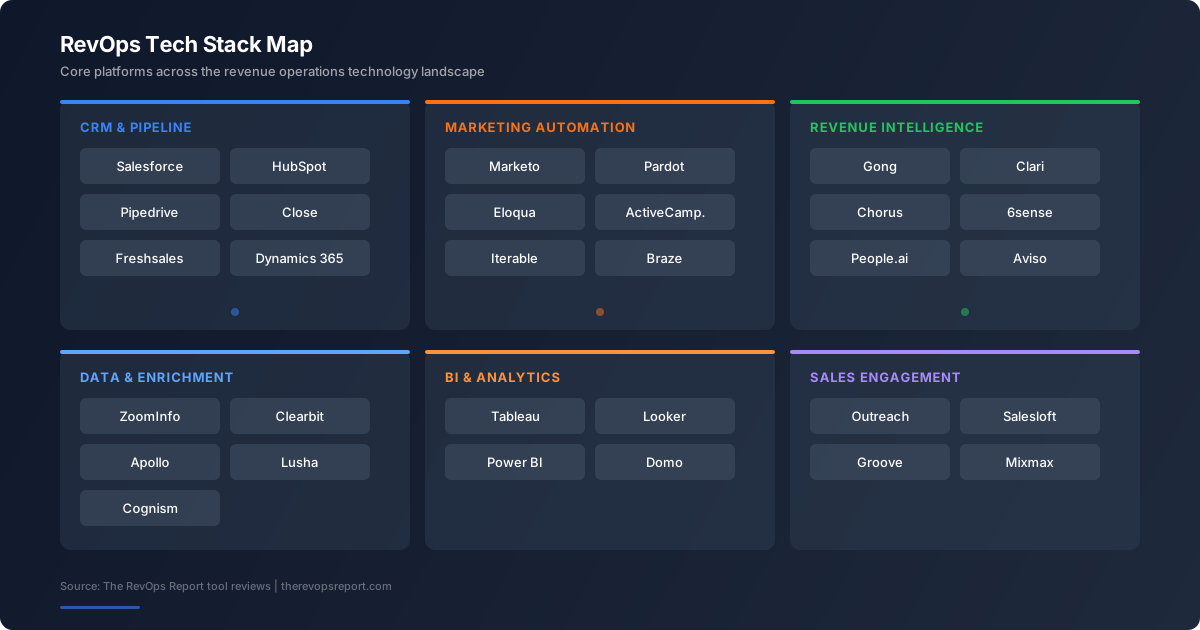
RevOps tech stack map showing CRM, marketing automation, revenue intelligence, data enrichment, BI, and sales engagement platforms
FactorChili PiperLeanData
PricingFrom $30/user/mo (Instant Booker) to $150+/user/mo (full platform)From $39/user/mo Similar range
Best ForInbound scheduling, speed-to-lead, meeting handoffsLead-to-account matching, territory routing, Salesforce ops
Core StrengthInstant booking from web forms Best in classLead-to-account matching at 95%+ accuracy Best in class
CRM PlatformSalesforce and HubSpotSalesforce-native Deepest SF integration
Routing LogicRound-robin, ownership-based, form-based rulesTerritory hierarchies, weighted assignment, complex matching More sophisticated
SchedulingInstant Booker, Handoff, Distro Purpose-builtBookIt scheduling add-on
Implementation1-2 weeks Fast2-4 weeks
Visual Flow BuilderCondition-based routing rulesDrag-and-drop flowchart builder More visual

Detailed Feature Comparison

FeatureChili PiperLeanData
Instant BookingForm fill to booked meeting in one step Core feature, best in marketBookIt scheduling available but not the primary focus
Lead-to-Account MatchingBasic matching for routing purposesFuzzy matching with custom rules, 95%+ accuracy Best in class
Territory RoutingRule-based assignmentMulti-layer territory hierarchies with visual builder More sophisticated
Meeting HandoffsAutomated AE-to-AE and SDR-to-AE handoffs Purpose-builtNot a primary feature
QueuingQueue-based distribution with priority rules IncludedRound-robin and weighted assignment
AnalyticsSpeed-to-lead metrics, booking rates, no-show tracking Scheduling-focusedRouting performance, SLA tracking, match accuracy

When to Use Which

Choose Chili Piper When

  • Your primary problem is slow inbound response times and you need leads to book meetings from your forms instantly
  • SDR-to-AE or AE-to-AE meeting handoffs are a friction point where leads drop off between qualification and demo
  • You run on HubSpot (LeanData is Salesforce-only) and need a routing and scheduling tool that works natively
  • Scheduling links, round-robin distribution, and queue-based assignment cover your routing requirements without complex territory logic
  • Speed-to-lead is the metric you are optimizing for, and going from "we call them back in 4 hours" to "they book a meeting in 30 seconds" is the goal

Choose LeanData When

  • Lead-to-account matching accuracy is critical because leads must route to the account owner, not a random rep in a round-robin
  • Your territory model is complex: geographic, industry, account tier, named accounts, and partner overlays that need visual flow logic
  • You are on Salesforce and want a native solution that reads and writes records without middleware or API limitations
  • Routing accuracy matters more than routing speed: getting the lead to the right person is more important than getting them there fast
  • You need to route leads, contacts, accounts, and opportunities through the same logic engine with consistent rules

When to Consider Both or Neither

Running Chili Piper and LeanData together is a common enterprise pattern and it works well. LeanData handles lead-to-account matching and territory routing within Salesforce. Chili Piper handles the scheduling layer on top: once LeanData determines the right rep, Chili Piper books the meeting on their calendar. The combined cost is $70-190+/user/mo, but for high-velocity inbound teams with complex territories, each tool handles its piece better than any single tool handles both.

What This Means for Your Stack

RevOps-Specific Considerations

  • These tools solve different funnel problems. Chili Piper optimizes the conversion step (form fill to booked meeting). LeanData optimizes the assignment step (lead to correct rep). Diagnose your actual bottleneck before buying. If leads go to the right rep but wait 6 hours for contact, Chili Piper fixes that. If leads book meetings fast but land with the wrong rep 30% of the time, LeanData fixes that.
  • CRM platform is a hard constraint. LeanData is Salesforce-only. If you run HubSpot, it is not an option. Chili Piper supports both Salesforce and HubSpot. For HubSpot orgs needing routing, Chili Piper or HubSpot Operations Hub are the realistic options.
  • The "use both" pattern is worth evaluating seriously. Companies like Snowflake and MongoDB run Chili Piper for scheduling with LeanData for routing. The integration point is clean: LeanData assigns the owner in Salesforce, Chili Piper reads that ownership to present the correct calendar. If your inbound volume exceeds 500 MQLs/month and territories are complex, the combined stack often pays for itself in conversion rate improvement.
  • Speed-to-lead ROI is measurable. Research shows a 21x improvement in qualification rates when leads are contacted within 5 minutes versus 30 minutes. Chili Piper eliminates the gap entirely by letting leads self-book during the form submission. Track your current form-to-meeting time and calculate the conversion lift.

Winner by Use Case

Use CaseWinnerWhy
Inbound speed-to-leadChili PiperInstant booking from forms eliminates response time entirely
Lead-to-account matchingLeanData95%+ fuzzy matching accuracy with custom rules
Complex territory routingLeanDataMulti-layer territory hierarchies with visual flow builder
Meeting handoffs (SDR to AE)Chili PiperAutomated handoff scheduling with calendar awareness
HubSpot organizationsChili PiperLeanData is Salesforce-only; no HubSpot option

The RevOps Report's Verdict

Chili Piper and LeanData are not really competitors. They solve different problems at different funnel stages. Chili Piper is the best tool for turning form fills into booked meetings with zero delay. LeanData is the best tool for matching leads to accounts and routing them through complex territory logic in Salesforce. If you only buy one, buy the one that fixes your actual bottleneck. If inbound leads book with the wrong rep, that is a LeanData problem. If inbound leads wait hours before anyone contacts them, that is a Chili Piper problem. And if both problems exist, buy both. The combination is well-proven at scale.

What Changed Recently

  • Q1 2026: LeanData rolled out enhanced AI-driven matching for partner-overlay accounts and named-account routing within complex hierarchies. Chili Piper expanded Distro to support opportunity-stage handoffs, not just lead-stage handoffs.
  • Q4 2025: Chili Piper added native support for routing post-meeting actions like opportunity creation and follow-up sequences. LeanData released matching policies that respect ABM tier definitions from Demandbase and 6sense without custom field mapping.
  • Q3 2025: LeanData BookIt scheduling closed the feature gap with Chili Piper Instant Booker for round-robin booking from forms. The two tools are now closer in scheduling capability than they were a year ago, though Chili Piper still leads on speed and meeting handoff polish.
  • Mid-2025: Both tools shipped tighter integration with Salesforce Flow and Apex, reducing the need for custom code in routing logic. LeanData remains the deeper Salesforce native; Chili Piper added HubSpot Workflow triggers in parallel.

Frequently Asked Questions

Which is better for RevOps: Chili Piper or LeanData?

Chili Piper is the better tool for inbound-heavy organizations where speed-to-lead directly affects conversion rates. Instant booking from forms, automated handoffs, and scheduling links reduce response time from hours to seconds. LeanData is the better tool for organizations with complex territory models, lead-to-account matching requirements, and Salesforce-native routing needs. If your bottleneck is "leads wait too long for a meeting," buy Chili Piper. If your bottleneck is "leads go to the wrong rep," buy LeanData.

How does Chili Piper pricing compare to LeanData?

Chili Piper starts at From $30/user/mo (Instant Booker) to $150+/user/mo (full platform), while LeanData starts at From $39/user/mo Similar range. The right choice depends on your team size, required features, and budget. Check each vendor's current pricing page for the latest plans.

Can I use Chili Piper and LeanData together?

Yes, many RevOps teams run Chili Piper and LeanData in parallel. The key is defining clear ownership for each tool so data stays clean. Use native integrations or middleware like Workato or Tray.io to sync records between them. Before committing to both, verify the overlap doesn't create duplicate workflows or conflicting data sources.

What are the main differences between Chili Piper and LeanData?

Chili Piper turns form fills into booked meetings instantly. LeanData matches leads to accounts and routes them to the right rep through complex territory logic. Both tools sit in the "lead routing" category, but they solve different problems at different points in the funnel. Chili Piper is about speed: how fast can a lead go from form submission to a calendar invite. LeanData is about accuracy: how reliably can you match a lead to its parent account and route it through your territory rules.

Should I switch from Chili Piper to LeanData?

Switching from Chili Piper to LeanData involves migration costs, retraining, and potential downtime. Before committing, audit your current usage: if you're using less than 40% of Chili Piper's features, a switch may simplify your stack. If you're deeply integrated, the switching cost may outweigh the benefits. Run a 30-day pilot with LeanData alongside your current setup before making a full commitment.

Chili Piper vs LeanData: opportunity handoff differences?

Chili Piper has the more mature opportunity handoff workflow. Distro automates the SDR-to-AE handoff with calendar awareness and routing rules, and the 2025 expansion added opportunity-stage handoffs (AE-to-CSM at deal close, for example). LeanData handles opportunity routing through the same matching engine that routes leads, which is powerful but less polished for handoff scheduling specifically. If your bottleneck is the SDR-to-AE handoff dropping leads, Chili Piper is purpose-built for it. If you need opportunity ownership reassignment based on territory changes, account hierarchy updates, or vertical reorgs, LeanData handles the routing logic better.

LeanData vs Chili Piper for intelligent lead distribution?

LeanData wins on intelligent distribution when "intelligent" means matching, hierarchy-aware routing, and complex territory logic. The visual flow builder lets RevOps construct multi-layer routing trees with conditional branches, and the matching engine handles fuzzy company name matches at 95%+ accuracy. Chili Piper distributes via round-robin, queue priority, and ownership-based rules, which is sufficient for high-volume inbound but lacks the territory depth. For ABM motions, named-account programs, or partner-overlay scenarios, LeanData is the better distribution engine. For pure speed and inbound-form distribution to a flat rep pool, Chili Piper is faster to configure and run.

LeanData strengths and weaknesses for complex account hierarchies?

LeanData strengths: native handling of multi-level account hierarchies (parent-child relationships, ultimate parent rollups, partner-overlay accounts), match policies that respect existing Salesforce account hierarchies, and the ability to route based on ultimate parent ownership. Weaknesses: the configuration is heavy for orgs with messy or inconsistent hierarchies in Salesforce, and the visual flow can become unmanageable past 50+ branches. Implementation typically requires a 2-4 week professional services engagement for complex orgs. For clean hierarchies under 5 levels deep, LeanData runs well. For acquired-company spaghetti hierarchies, plan for hierarchy cleanup as a prerequisite.

LeanData alternatives for complex territories and account hierarchies?

The realistic LeanData alternatives in 2026 are Openprise (deeper data orchestration with routing as a feature), Distribution Engine on Salesforce AppExchange (lighter and cheaper for simpler territories), and Salesforce native Sales Cloud assignment rules with custom Apex (only viable if you have a strong Salesforce dev team). For ABM-specific routing, Demandbase and 6sense have built-in routing within their platforms but lack LeanData depth on lead-to-account matching. None match LeanData on visual flow builder for complex multi-tier territories. If you have outgrown LeanData, the realistic upgrade is custom Salesforce dev work, not another product.

LeanData vs Chili Piper differences for routing and scheduling?

Routing: LeanData wins on lead-to-account matching, complex territory logic, and Salesforce-native depth. Chili Piper handles round-robin and ownership-based routing well but does not match leads to accounts at the same accuracy. Scheduling: Chili Piper wins on instant booking from forms, SDR-to-AE handoff workflows, and meeting analytics. LeanData BookIt closed much of the scheduling gap in 2025 but Chili Piper still leads on speed and polish. Net: LeanData for the routing layer, Chili Piper for the scheduling layer. Many enterprise teams run both and let each tool do its piece.

Chili Piper vs LeanData: best inbound meeting scheduling and routing in B2B sales tech?

For pure inbound meeting scheduling, Chili Piper is the category leader and has been since 2018. The Instant Booker workflow remains the fastest form-to-meeting motion in the market. For inbound routing accuracy (matching the lead to the right rep before scheduling), LeanData leads. The "best" depends on which step matters more: if you can tolerate a few minutes of routing delay in exchange for matching accuracy, LeanData first then a scheduler. If the form abandonment risk is higher than mis-routing risk, Chili Piper first then accept some manual reassignment. Most enterprise inbound motions need both layers.

Chili Piper vs LeanData: opportunity handoff scheduling?

Chili Piper Distro is purpose-built for opportunity handoff scheduling. When a lead converts to an opportunity and ownership changes from SDR to AE (or AE to CSM at close), Distro automates the calendar handoff with the new owner without manual coordination. LeanData routes opportunity ownership but does not schedule the handoff meeting natively (BookIt can be configured but it is more setup work). For fast-moving inbound motions where the handoff happens within hours, Chili Piper Distro produces the cleanest end-to-end experience. For slower enterprise sales cycles where handoff timing is less time-sensitive, LeanData routing plus manual scheduling is sufficient.

Get Weekly RevOps Intelligence

Tool reviews, salary benchmarks, and stack recommendations for RevOps leaders.

Subscribe Free
Disclosure: The RevOps Report may receive affiliate compensation from tools mentioned here. Our analysis is independent. Every claim is based on publicly available data and user feedback.
Last Updated: May 2026